Thursday, March 17, 2011

Ready Readers - Quizative Questions

WHO? WHAT? WHERE? WHEN? WHY? HOW?  These words are my daughter's most frequently utilized words.  Maybe I should rephrase that, these are the words that my daughter uses to drive her parents crazy on a DAILY basis!  While, yes, her constant questions easily drive me up the wall, it is hard to get upset about it, as I know that her little mind is always clicking and ticking. 

Any  parent of a child over the age of 2, can use this developmental stage to begin to help their child become more involved in literature. The word here is MODEL.  SHOW your children HOW to ask questions about a text that you are reading.   In addition to this list of question words, start working on concepts of story grammar and vocabulary.   Talk to your children about who the CHARACTERS are in the story. USE the work CHARACTERS.  Talk about SETTING, PLOT and even what happens in the BEGINNING, MIDDLE, END and CONCLUSION of the story. 

You may be asking, WHY is it SO important that I use the terms, character, setting, plot, beginning, middle, end and conclusion?  Simple, these are appropriate terms for the parts of a fictional story. 

Before you start a book, take some time to look at all the pictures on each page and discuss what you see happening in the story (this is a classic techinuque used be primary teachers who are teaching reading, called a picture walk.)
  • Have your child PREDICT, what will happen in the story.
  • Request them to ask QUESTIONS, "like mommy does" about the story, using the question words.  You can offer a word to get them started.  "Use where to ask me a question about this page."
  • If your child has been practicing letter names or sounds.  Use the pictures to help them identify letters, sounds or even words.  Your child finds a "cat" in the picture.  You can say:
    • "cat stats with the letter c, can you find a word on this page that starts with the letter c?"
    • or, "cat starts with the sound /c/ can you find the word that starts with the /c/ sound?"
    • or, "can you find the word that probably says cat?"
  • As you are reading continue to have your child ask questions, as though the parent is the kid or student.
  • Also ask your child if they need help clarifying words that they do not understand.  Again, you can roll play this and pretend to switch roles.  You can be silly and have fun, you can turn to your kid and say, "Mommy, what does the word excited mean?  Can you please clarify that word for me?"
Have fun reading with your child and use your sense of silliness and sense of humor!  : )


Please share your reading ideas with us!  ALSO if you want more ideas or have any questions about these techniques please let me know and I will clarify information here and/or in future blogs! 

I love that I can use this blog to continue to help education children by educating their parents, too!  : )

Monday, March 7, 2011

Guiltless Engagement


Guilt is a mom's middle name.  We worry that we do not feed our kids enough veggies, that we let them watch too much TV, that we do not dress them cute enough, the list goes on and on!

Often as a mom, we have a hard time just trying to find time for ourselves.  

While my darling daughter does love to play, and plays well alone, I am often a little tentative about leaving her alone to play while I run off to enjoy a bath or to unload laundry.  More than once I have returned to her playroom sanctuary to find that she has dumped several of her board games onto the floor along with all of it pieces. 

A surefire way to prevent this is to tune into "Dora" and she will be mesmerised by the little girl and her monkey friend, long enough to prevent her from causing more chaos.  While she does get engaged into the show, including yelling commands in Spanish, I worry about the amount of television my little potato watches.

Today I had one of the most relaxing baths, that I can while my hubby is at work, and while she is still awake (I am starting to discover that those daily naps are disappearing!!).   She begged me to do YOGA while using a DVD.   These DVDs were purchased for my classroom of students several years ago, as a fun alternative activity that my 2 dozen youngsters can enjoy on a rainy day.  It has been a great parenting tool too! 
Her favorite DVD is the ABC one, which I also love!   Her favorite pose in the series she tells me is,
R for Rocking Horse," and then she demonstrates this pose that builds strong back muscles and confidence!  I CAN take a bath again,without being afraid of a mess that will be sitting in the middle of our playroom, when i return.  

Namaste'

Mommy, the Micromanager

I will admit it!  I have done it!  I have micromanaged my child's life, but I have admitted it, and that is the first step, right?!

Micromanaging parents are the ones who plan every minutia of their child's day.  They can also be defined as the parents who nitpick their children to death!

As all of blogs, this topic came to me, as I observed other parents with their children.  I watched as a mother and father hovered over their 2 year old like a rescue helicopter.    It immediately hit me, "Do I DO THAT???!"

Now remember, what I am NOT is judgmental.  I don't judge other parents for their actions and reasons for what they do. hey, who am I to judge?  I am a still a rookie parent, myself!  What I am, though, is a learner and a teacher.  I learn about the world, through watching others, and reading and researching children.  I then, in turn teach others about what I am experiencing, in the hope that I help enlighten my friends, or take a little stress out of your day!

SO, here are my thoughts on managing children.  Again, it goes back to your main goal as a parent!  (see my first post of the blog.)  If what you are telling your children to do does not relate to their  or another's health and well being, then it is probably not necessary.   In short, as my mother would say, "choose your battles."   If your child is doing OK and they will not get hurt or hurt another, then they probably should be left alone to discover and express themselves. 
Party girl Daisy, choose this outfit this weekend.  I got lucky on her choices!   Maybe that, or I have begun to buy all of her clothes to coordinate each other!  : )

So, I let my child choose her own clothes, as long as the weather permits her current "style."  After all what does it hurt if she is wearing a green top, yellow polk-a-dot leggings, and a purple tulle skirt?  She might looks silly, but who cares?   Most people will look at her and know, she IS a THREE year old!  

If you have not yet had the change to pick-up my current bible on preschoolers, then now is the chance!  I am not kidding with you, when I say that it talks about every possible situation that you will find yourself in. 


On the other hand, many of you have younger children.   Dr. Nelson, also writes books for that age too!

Maybe you really want to get someone else on the same page, as YOUR parenting, such as your spouse or a grandparent.   Buying them this book, is a great hint, and they will LOVE how easy of a read it is!  (My hubby has his own copy next to the bed on the night stand, as I type! I am hoping that it will work for us, and help us get on the same page!)


Tuesday, March 1, 2011

Nutritional Noshing

Young children snack all the time.  (Ok!  That is it!  No more words of wisdom!  DONE!)

All joking aside, beyond the 3 squares a day (or not so square if you are a toddler) your child can sit, stand, run and sleep while snacking throughout the day.

Careful choices on your part, as a parent can make them empty calories, or beneficial, nutrient rich calories.

My friend Michelle and I used to joke when our daughters were about a year old, whether or not they could sustain themselves on blueberries and breast milk.  Since Michelle was also Daisy's caregiver during the day (back in the day when I was a "traditional teacher" in a traditional classroom), she feed my daughter alongside hers.  The two cuties got into the groove of only eating the (ORGANIC!) blueberries that were given to them, and nothing else!  Luckily neither one of them had any crazy side effects, such as skin turning blue (as child would turn ORANGE if they only ate carrots!  True!). On the other hand if they only ate donuts and milk, then we would have a REAL issue on our hand!  Luckily donuts and other such food were never introduced as an option to their diet!

On that note, one of my equally as health conscience friends, Ginger recently raved about a great idea regarding her son's nutrition.  He is still 6 or 7 months old, so he is still in the category of a limited diet, as many infants still are, and should be.  She concocted a teething biscuit that she believes he likes, and eats heartily,and that she feels comfortable feeding him.
She sent me the recipe below:
she informally titled them:

DELISH BISCUITS
Preheat oven to 425
1c flour
1c baby cereal
3TBS oil
ICE Cold Apple Juice about 8oz (I juiced mine fresh and then added the pulp too)

Mix flour, cereal, and oil, then slowly add the cold juice until a dough forms and begins to pull away from the bowl. Roll flat, cut into shapes, bake about 25-30 minutes.

(thanks for sharing Ging!)     : )

As you may have noticed, I emphasized the fact that the produce that I serve to my child is organic.  I am very careful that I choose such an option for my child, as produce that is "labeled" organic tends to be a little more trustworthy, as far as farming practices.What is sprayed on and around the produce is monitored a little more carefully, this contributes to the health of the soil, water and humans.  I am also lucky to live in the middle of California's agriculture land, so much of what I  am able to purchase is not only local but ALSO organic.  While my hubby, Mr. Penny-Pincher (and also a Science teacher,with a degree in environmental sciences, so he should KNOW better), often scoffs at me and my organic purchases, he cannot deny that our child is healthy and that an extra 50 cents for a basket of produce that makes me happy, is more than worth it!

If you are interested in the topic of toxins in our environment and how they effect us read:

Friday, February 25, 2011

Providing Power

Just a little out of reach, my toddler stretches up to grab the gymnastics bar during our weekly gymnastics "mommy and me" class.  What do most parents do?  Grab their kid and boost them up?  Not me!  I look at her and say, "Need a boost?"  In this case, a fist does the job.  I ball up my hand, kneel on the ground and say, "OK step up!"  She steps up on my hand giving her any extra three inches and she clasps onto the bar with both hands and flips her feet up to the bar to hang upside down. She smiles at me and says, "I did it!"  SHE  truly DID do it!
I will do it alone, Mommy!

After several years of teaching and as well as a few years as a parent I have acquired one belief that has stuck with me and has helped to form a philosophy of parenting.   I do not EVER enable my child.  In this sense, I NEVER take my child's (or students') abilities away from them.

You can think I am mean, but if you listen carefully how I give children power, you too might think differently about how you HELP your children (at ANY age!).
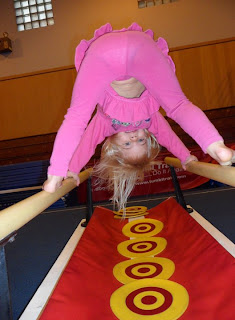
I am fearless!

As a teacher we talk about how children learn within their ZONE of proximal development.
Let's take a little bird walk with this one, and I will share an AH-HA moment with you:
One of my greatest prides and joys is in my life was  "the conversion" of my hubby from a self centered (OK he still is a little of that too, but...), "I only want to work a job where I can be alone in my solitude" arborist, to a well loved, talented MIDDLE SCHOOL (no doubt!) Science teacher!  HA! 
It might have been my well known, contagious energy for teaching and kids, that did, or it might have been a little of the 9 month work year jealousy (man was he ever wrong about that one!!), but at one point he decided to "become a teacher too!"  It started with a few hours a week of volunteering, to branching out to help my colleagues, then to becoming an occasional sub, and finally to enrolling in a credential program, that did it!

It was during one of these Theory or philosophy classes that he came home to tell me about his "AH-HA!"  His class was talking about the Zone of Proximal Development.   Life and education all of a sudden made sense to him.  The concept of children tuning our learning (or filtering information) when it is too easy or too hard for them was foreign to him. BUT IT MADE SENSE!

As parents, we know that we don't want to make things too hard for our child, for fear of them rejecting the objective, but too easy is just as detrimental to their learning and their psyche!  As adults we all know about this, we do not want a job that is "beneath" our abilities, and we really do enjoy a challenge that we know that we can carry out. 

How often do we do this to our children?   I cannot help but think, as a teacher HOW OFTEN students are let down when the bars a lowered for them.   What would have happened if I had picked up my daughter and carried her over to the bar and placed each hand on the bar, and then going that extra step, I swung HER legs up to the bar to help her hang upside down? She would not learn how to stretch her self to meet her actually abilities, and she would not get any stronger. Parents and teachers do this to children ALL THE TIME!  : (  It makes me very sad and frustrated.  Are you telling your kids, "it is OK, you can't do it, so I will help you."?

It has been my motto for children in my life, to say, you need to stretch or you will never grow.   Encouraging children to challenge themselves and for their caregivers to challenge THEM, they will INDEED grow.


Do you have a toddler in your care?   Here are some great examples of ways that you can include, teach and ask YOUR children to grow!
  • Teach your child how to help themselves with daily tasks
    • teach them how to drag a chair or stool to the sink to wash their own hands after using the bathroom
    • have a special place where you store plastic cups and bowls (BPA-free of course!) so that they can get their own sip of water, or bring you bowl when they want a snack of cheerios
      • make these plastics their responsibility while unloading dishes (my daughter has been helping with her plastics since she was about 15 months old
  • Give your child many opportunities to try something new
    • if you sign your child up for a new class or offer a new task, positively encourage them to keep trying and the routine itself will be a learning experience.  
    • stop a task before it gets too repetitive or before they get tired of it
  • do not create a situation that  you cannot easily assist with (too difficult)
  • do not act as a scapegoat if your child is not in harm's way
  • give them a helping inch not a mile!
  • create routines that are age appropriate (my daughter is expected to clean up toys as she completes playing each one of them, she knows that all her art supplies go back in their storage unit, with a drawer for crayons, one for markers, one for paper, etc.)

Give your child POWER and do not take their ability to grow and achieve away from them.  

Do you have some ideas how you give your children the POWER to learn and grow?

Thursday, February 24, 2011

Ready Readers - Picture perfect (coming soon)

Ready Readers - Learning Letters

As parents, who are always looking for ways to give our children any advantage to become more ready for Independence, we are all interested in ways to make our preschoolers more ready for their first experiences of school. 

As a teacher with years of experience in early literacy and with working with children in the early grades, I am most concerned with my child's readiness for learning how to read.  There is a direct correlation of students who are early readers with their future success in school.  That being said, I would like to share with fellow parents some simple tricks to get your child engaged in learning early literacy skills.

While many articles will tell you that all you need to do to get your child ready to for Kindergarten is read TO them.  I agree with that, as children should LOVE to be read to and LOVE books. Exposure to books with do that!  I will offer some great ideas for helping your child learn literacy grammar, in a later post.  This one is much more rudimentary: teaching your child their alphabet. 

When I was a student, Kindergarten was ALL about the alphabet.  Each day we would learn a new letter, draw and color pictures that had the same initial sound.  Now your kindergartners are expected to learn all 56  letters (upper and lower case) early in the year.  They are now expected to apply that new knowledge of letter sounds to begin to sound out CVC (consonant-vowel-consonant) words, like cat, tin, and pit. They are also expected to begin to identify the most common 50 sight words (words that cannot be sounded out using conventional rules).  Finally they begin to use their new-found knowledge to begin composing their own sentences. 

Firstly, I will tell you that honestly, young children are VERY capable of learning how to read and write at the levels that are expected to in their classrooms. Secondly, children will be even MORE ready if parents take the basic steps to HELP to prepare them for these high expectations.

Here are some simple ways to begin to expose your child to the alphabet.
  • Starting at age 1, begin singing the alphabet song to and with your child.  This is not as difficult for them to learn as you would think.  By this time in their life, they will have become very familiar with the tune as it is the same tune, as the all time favorite, "Twinkle, Twinkle"
  • Start teaching letters as objects and shapes.  Your young toddler can identify animals by name, letters are the same thing. They have distinguishable shapes and features that will help your child to recognize them.
  • Choose letters that included in your child's name.
  • Choose letters that are very similar in both upper and lower case (o, s, m, n, p)

Here is how you start introducing letters as shapes.  Purchase a set of lower case magnet letters for the fridge. 
  • Play with the letters, arrange them, talk about their color, the shapes, (curvy, straight, etc)
Next time you curl up with a good book with your child, choose one of those simple letters (o, s, etc) off of the fridge and have them hold them while you read stories.  Occasionally have them play "I spy" while looking for that letter.  Call the letter by name.
Point out the letters that you have exposed them to, in your daily environment (I will NEVER forget the day that my daughter, not even 2 years old, yet shouting out in the car. "Mom, daddy, I see the letter s! letter S!"   She saw it on a sign on some building.  A majoity of our waking hours are spent as just mommy and Daisy, so I was pleased that my husband was along to witness her brilliance, first hand!  

Soon, as your child starts to learn 10 letter names or so, invest in a letter/ picture chart that you can hang on the wall.  Your kid will love their new "toy" and you will love helping them sort the pictures into the pockets. 
It is likely that your little one will be able to identify the pictures, but soon they will start to recognize the initial SOUNDS that they hear and they will connect them with the letter names.  Early on, kids will start to HEAR the letter sounds in the letter names.  "Snake starts with /s/,  it sounds like "essss". 

If you have any fun ways to share with us, how you help your child to learn their letter names and sounds.  I have not yet touched on the topic of having your child use writing implements to practice their new letters.  This will also be an upcoming topic, as well!